Performance marketing on a small budget: CAC, ROAS and when to stop spending
Most small businesses that "tried ads and it didn't work" never did the arithmetic first. They spent too little for the platform to learn, measured clicks instead of customers, and stopped at the wrong moment. Here are the three sums to do before you spend, and the rules for when to stop.
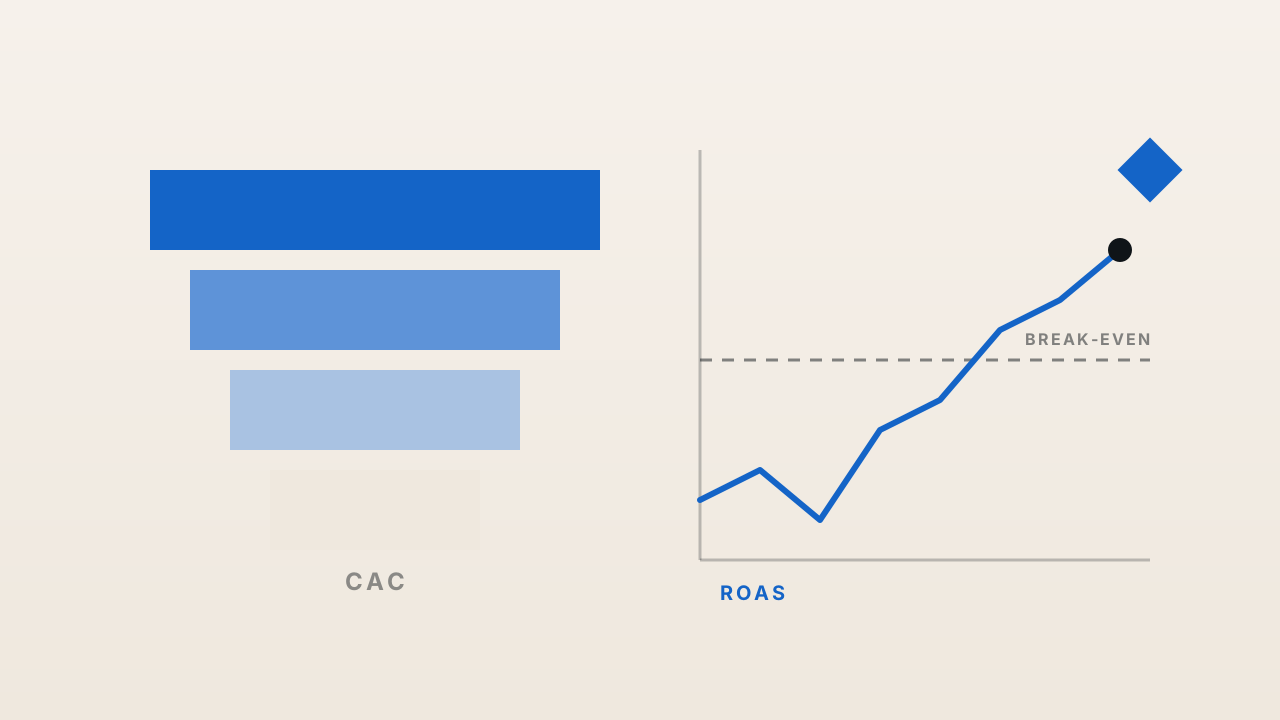
Performance marketing means paying for ads and judging them by measurable outcomes: leads, sales, bookings. That is its strength. It is also why it punishes guesswork faster than any other channel.
Sum 1: what can you afford to pay for a customer?
Customer acquisition cost (CAC) is total marketing and sales spend divided by the number of new customers it produced. The question is not "what is a good CAC?" but "what CAC can this business survive?"
For a one-time sale, the ceiling is your gross profit per order. For repeat business, it is the gross profit a customer brings over their life with you, discounted for how long that takes.
If you sell online, convert that into a break-even ROAS (return on ad spend):
Break-even ROAS = 1 ÷ gross margin
| Gross margin on the product | Break-even ROAS | What it means |
|---|---|---|
| 60% | 1.67x | Every ₹1 of ads must bring at least ₹1.67 of sales |
| 40% | 2.5x | ₹2.50 of sales per ₹1 of ads |
| 25% | 4.0x | Hard to sustain on cold traffic |
Anything below break-even is buying revenue at a loss. If your margin is 25% and the ads return 3x, the dashboard looks healthy while the bank balance shrinks. Include GST correctly: ROAS should use sales net of GST, and the ad cost net of any input tax credit you can claim on the platform's invoice.
Sum 2: how much does the platform need to learn?
Ad platforms optimise by learning who converts. Meta's published guidance is that an ad set needs about 50 optimisation events within seven days to leave its "learning phase" and stabilise delivery. Below that, it shows "Learning limited", and costs stay noisy.
That gives a minimum budget per ad set:
Minimum weekly budget ≈ expected cost per event × 50
| You optimise for… | Expected cost per event | Minimum weekly budget per ad set |
|---|---|---|
| Purchases at ₹800 each | ₹800 | about ₹40,000 |
| Enquiry forms at ₹300 each | ₹300 | about ₹15,000 |
| WhatsApp conversations at ₹60 each | ₹60 | about ₹3,000 |
What this means for small budgets: run fewer ad sets, not more. One ad set with ₹15,000 a week learns; five ad sets with ₹3,000 each do not. If your budget cannot buy 50 of your real goal, optimise for a more frequent event that still predicts it (an enquiry instead of a sale) and measure the real outcome in your CRM.
Avoid big edits during learning. Changing targeting, the optimisation event or the budget by large steps restarts it.
Sum 3: how long until the money comes back?
CAC payback is how many months of gross profit from a customer it takes to recover what you paid to acquire them. For a services firm or subscription, under 12 months is healthy for a bootstrapped business; beyond that, ads are consuming working capital your business may need elsewhere. Our working capital article explains why this matters even when you are profitable.
Search or social: where to start
| Google Search ads | Meta (Facebook and Instagram) ads | |
|---|---|---|
| Catches people who… | Are already looking for what you sell | Did not know they wanted it yet |
| Best for | Clinics, local services, B2B services, urgent needs | D2C products, events, education, visual categories |
| Typical small-budget trap | Broad keywords that attract researchers, not buyers | Too many ad sets to learn; judging by likes |
| First thing to fix | Negative keywords and a focused landing page | Creative: most results come from the ad itself |
For a local service business, do the free work in our local SEO article before spending on either.
When to stop, and when not to
Do not stop in the first seven days or before about 50 events. Early costs are always worse than settled ones.
Stop or rebuild when any of these is true after the learning period:
- Blended CAC is above what a customer is worth, and three rounds of new creative have not moved it.
- ROAS is below break-even for four consecutive weeks.
- Leads are cheap but your sales team closes almost none. That is a targeting or offer problem, not a budget problem.
- You cannot tell which customers came from ads, because nobody records the source. Fix tracking first.
The measurement you need before spending
- A conversion event that fires on the real outcome (form submit, purchase, booked call), tested.
- Every lead recorded with its source in a CRM or at minimum a spreadsheet.
- A weekly review of spend, leads, customers and revenue from those customers, not platform metrics alone.
- A consent line on your forms; see our DPDP article.
The honest summary
Ads do not fail because small businesses are small. They fail because the budget is split too thin to learn, success is measured in clicks, and nobody knows the break-even number. Do the three sums first. If the numbers do not work at your margin, the answer is to change the offer or the channel, not to spend more.
Rasika's Performance Marketing service starts with these three sums and tracking set-up, then runs campaigns against a break-even target you approve.
Frequently asked questions
How do I calculate break-even ROAS? +
How much budget does a Meta ad set need? +
Should a small business start with Google or Meta ads? +
When should I stop an ad campaign? +
What is a good CAC payback period? +
Sources (checked 1 October 2026)
- The Digital Ring: Meta ads learning phase (50 events in seven days after the last significant edit; Learning Limited)
- Benly: learning phase optimisation (edits that reset learning)
- Google Business Profile Help: local ranking (for the local-first recommendation)
This article is general information, current as of 3 October 2026. It is not legal or tax advice for your specific situation.