NDAs, MoUs and founders' agreements: which one when
Three documents show up in the first months of almost every new business, and get confused for one another constantly. Here is what an NDA, an MoU and a founders' agreement each actually do, and when each belongs.
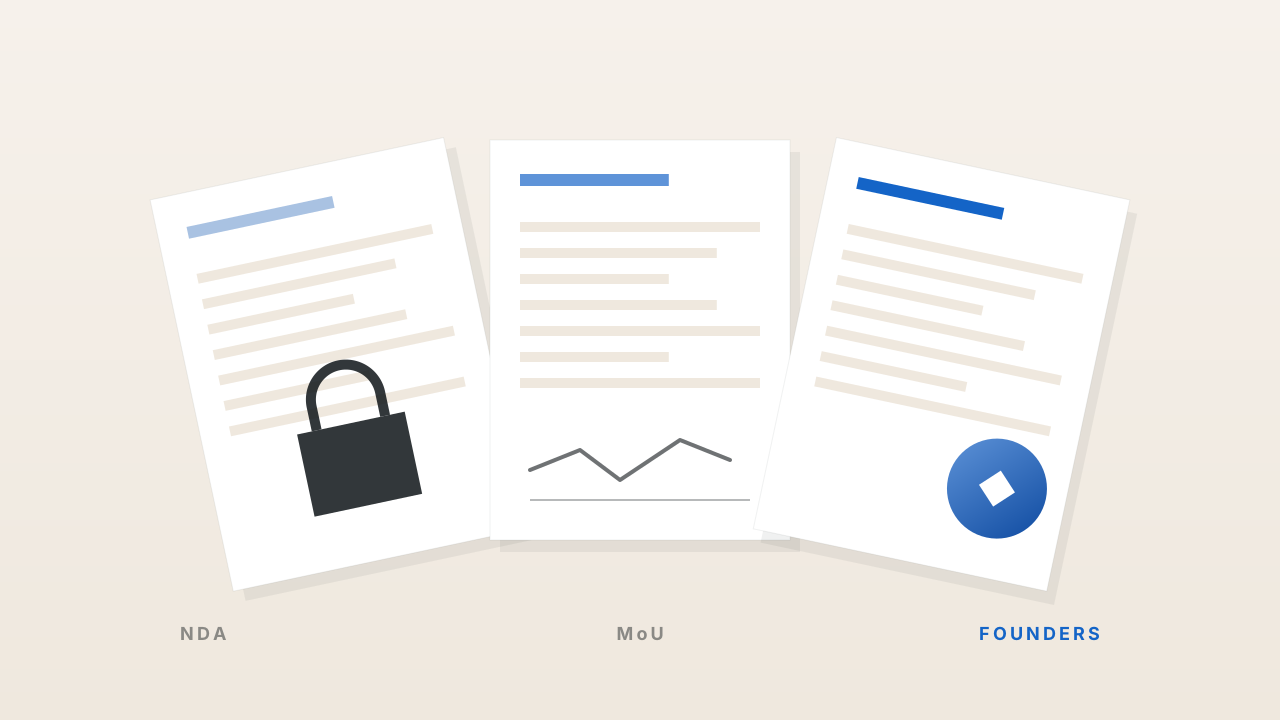
Three documents tend to show up in the first months of almost every new business: an NDA, an MoU and a founders' agreement. They get confused for one another, downloaded from random templates, signed without much thought, and then either forgotten or fought over later. Each does a genuinely different job, and using the wrong one for the moment is how founders end up unprotected exactly when it matters. Here is which is which, and when each belongs.
The NDA: protecting information
A Non-Disclosure Agreement is the narrowest and most common of the three. Its single job is to keep confidential information confidential. When you are about to share something sensitive (your product roadmap, customer data, financials, a proprietary method) with someone outside the business, an NDA legally binds them not to disclose or misuse it.
When you need it: before sharing sensitive information with a prospective partner, vendor, contractor, employee or, sometimes, an investor (though many established investors decline to sign them early). The key features to get right are the definition of what counts as confidential, the duration of the obligation, and whether it is one-way (you are disclosing) or mutual (both sides are).
What it does not do: an NDA does not create a partnership, define who owns what, or commit anyone to a deal. It only governs information. Reaching for an NDA when what you actually need is an ownership agreement is a common and costly mismatch.
Two recent changes widen where confidentiality clauses matter. The Labour Codes now require a written appointment letter for every worker, which is the natural place for confidentiality and IP terms. And if a vendor will handle your customers' personal data, the DPDP rules make you accountable for what they do with it, so the contract needs a data clause, not just an NDA.
The MoU: recording an intention
A Memorandum of Understanding records that two parties intend to work together and sets out the broad shape of that arrangement before a full, binding contract exists. It is the "we're agreed in principle, here's roughly what we mean" document: useful for capturing alignment, signalling seriousness, and giving both sides a reference point while the detailed contract is drawn up.
When you need it: at the start of a collaboration, partnership discussion or deal that is agreed in spirit but not yet papered in full: a joint venture you are exploring, a supplier relationship taking shape, a partnership being scoped.
The crucial nuance: an MoU is usually non-binding as to its commercial terms, but not always, and the line depends on how it is drafted, not on the label at the top. An MoU written in definite, obligation-creating language can be enforced as a contract. So the mistake to avoid runs both ways: do not treat an MoU as casually non-binding when its wording commits you, and do not rely on an MoU for protection that only a proper contract provides. If it matters, the drafting matters.
The founders' agreement: defining the inside
If the NDA and MoU look outward, the founders' agreement looks inward, and it is the one founders most often skip and most often wish they had not. It is the document among co-founders that settles the questions everyone assumes will sort themselves out and that, unaddressed, end more businesses than competition ever does:
- Equity split: who owns how much, and why.
- Roles and decision-making: who is responsible for what, and how disagreements get resolved.
- Vesting: so a co-founder who leaves in month four does not walk away with a quarter of the company. Four years with a one-year cliff is common.
- What happens if someone leaves, voluntarily or otherwise.
- IP ownership: confirming the company, not an individual founder, owns what is built. The same applies to work by freelancers and agencies, who usually keep copyright unless it is assigned in writing.
- Dispute resolution: the mechanism for when founders disagree.
When you need it: as early as possible, ideally before or right alongside incorporation, while everyone is aligned and goodwill is high. A founders' agreement negotiated when the relationship is good is a calm, sensible document. The same conversation attempted after a falling-out is a dispute. It is also one of the first documents an investor's lawyer asks for; our investor readiness checklist explains why.
| Document | Its job | Its moment |
|---|---|---|
| NDA | Protects information | Before sharing anything confidential |
| MoU | Records an intention | When a deal is agreed in principle, not yet in full |
| Founders' agreement | Defines the inside | At or before incorporation, while aligned |
The template trap. All three are freely available as templates online, and that is exactly the problem. A generic NDA may not actually cover your confidential information; a founders' agreement copied from a US startup may not sit correctly under Indian law; an MoU with sloppy wording can bind you when you thought it would not. A template gives you the comfort of a signed document without the protection of a correct one, which is arguably worse than nothing, because it stops you seeking the real thing.
The order they usually appear
In practice, the founders' agreement comes first and earliest, settling the inside of the business while everyone is aligned. NDAs appear continuously, whenever sensitive information is about to be shared. The MoU shows up when a specific external collaboration starts to take shape, ahead of a full contract. Each has its moment; the skill is matching the document to the situation rather than reaching for whichever template you happen to have. Our napkin-to-business map shows where each fits in the wider setup.
Where we fit
Getting these right is part of building a business on solid ground rather than borrowed paper. As part of the Establish practice, we prepare the foundational documents a new business actually needs, drafted for your situation and correct under Indian law, not pulled from a template that almost fits. If you are about to sign something, or you are realising you should have a founders' agreement and do not, that is worth a conversation before the signatures, not after.
Rasika's Legal Documentation service prepares the foundational documents a new business needs, drafted for your situation and correct under Indian law, not pulled from a template that almost fits.
This article is general information, current as of 3 October 2026. It is not legal or tax advice for your specific situation.