What ₹500 buys you: why Udyam is the best first registration
It is effectively free, takes twenty minutes, and quietly unlocks more than almost anything else in your first year. Here is what Udyam, the MSME registration, actually buys you, and why it tops the list.
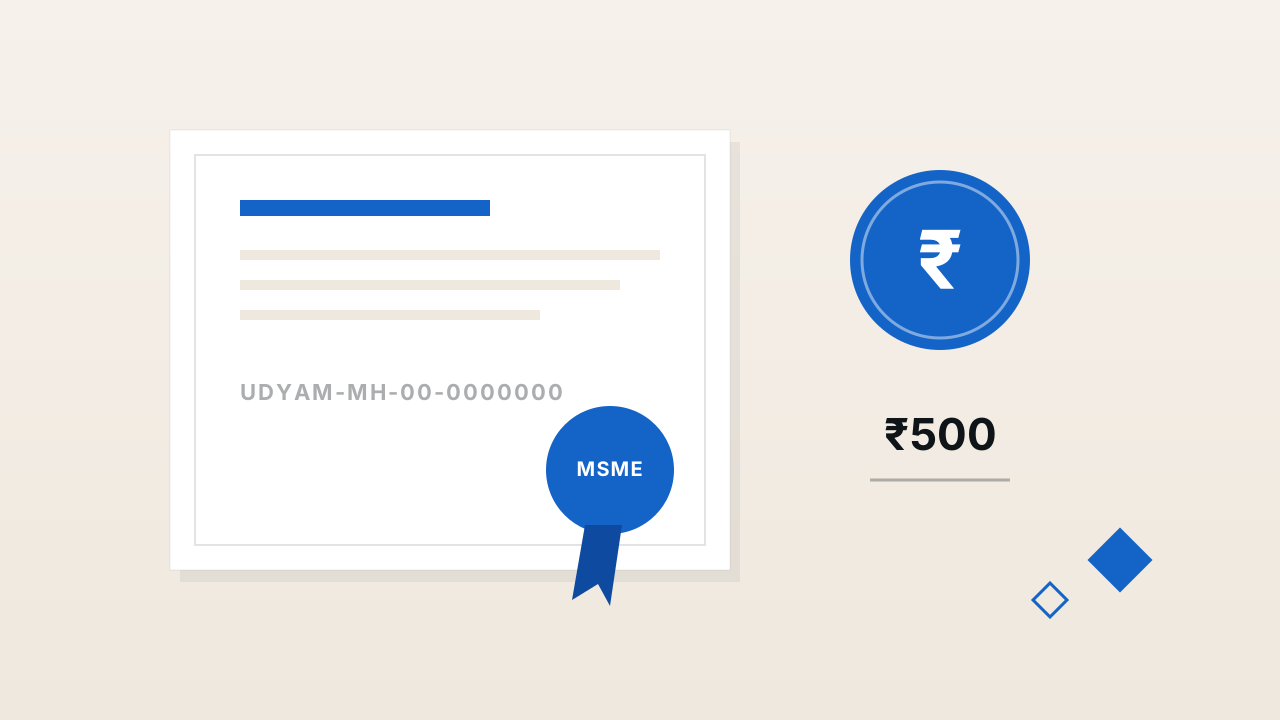
Of all the registrations a new Indian business can get, one stands out for an unusual reason: it is effectively free, takes about twenty minutes, and quietly unlocks more than almost anything else you will do in your first year. That is Udyam, the government's MSME registration, and the fact that it costs nothing on the official portal is exactly why it is so often skipped or, worse, paid for unnecessarily through a third party. Here is what it actually is, what it buys you, and why it deserves to be near the top of your list.
What Udyam actually is
Udyam Registration is the Government of India's system for formally recognising a business as a Micro, Small or Medium Enterprise (MSME). Launched in its current form in July 2020, it gives your business a permanent registration number (URN) and an e-certificate: in effect, an official MSME identity, a kind of Aadhaar for your enterprise. It makes your business "machine-readable" to India's lending, procurement and compliance systems. Banks check it, government platforms require it for vendor onboarding, and large corporate buyers verify it for their MSME purchasing programmes.
The classification is based on your investment and turnover, self-declared. The limits were raised from 1 April 2025, so most new businesses comfortably qualify as micro:
| Category | Investment in plant, machinery or equipment | Annual turnover |
|---|---|---|
| Micro | Up to ₹2.5 crore | Up to ₹10 crore |
| Small | Up to ₹25 crore | Up to ₹100 crore |
It is genuinely free. Registration on the official portal, udyamregistration.gov.in, costs nothing: no government fee, no document uploads, just Aadhaar verification and tax-linked validation. Be wary of third-party sites that charge a "registration fee"; the official process has none. The only thing of value a partner adds here is making sure your details are entered correctly so the certificate issues clean.
What ₹500, or nothing, actually buys you
The registration itself is free; if you have someone handle it for you, it is a nominal fee (we do it for ₹500). For that, here is what opens up.
Cheaper credit, and collateral-free loans
MSME status is the key to priority-sector lending (banks are mandated to lend to MSMEs) and to collateral-free loan schemes under government credit guarantees. For an early business with no assets to pledge, this is often the difference between getting working capital and not. It also tends to mean lower interest rates than an unregistered business would be offered. Our guide to why profitable businesses run out of cash explains why arranging that credit early matters.
A halved government fee on your trademark
This one pays for itself many times over. The government fee for filing a trademark online is ₹4,500 per class for individuals, MSMEs and recognised startups, against ₹9,000 per class for other companies and LLPs. If your business is a company or LLP, registering for Udyam first (free) literally halves that statutory cost. Protecting a wordmark and a logo across even one or two classes, the saving dwarfs any fee you would pay to get Udyam done. Our guide to trademark classes explains how many classes you actually need.
Protection against delayed payments
The MSME framework gives registered micro and small enterprises that manufacture or provide services a strong legal lever against slow-paying buyers: payment within 45 days of acceptance (15 without a written agreement), compound interest at three times the RBI bank rate if they are late, and, for the buyer, the loss of a tax deduction if the invoice is still unpaid at the year end. Traders and medium enterprises are outside this protection. Our article on the 45-day rule shows how to use it, from the line on your invoice to a complaint on the MSME Samadhaan portal.
Tender preferences and scheme eligibility
Government tenders frequently carry MSME preferences: set-asides, relaxed eligibility, exemption from earnest-money deposits. And a long list of central and state subsidy and support schemes use your Udyam number as the entry credential. Without it, you are simply not in the room for any of them.
| Udyam unlocks | Why it matters |
|---|---|
| Priority and collateral-free lending | Working capital without assets to pledge |
| Halved trademark government fee | ₹4,500 instead of ₹9,000 per class for a company or LLP |
| Delayed-payment protection | 45-day limit and penalty interest for micro and small suppliers of goods or services |
| Tender preferences and schemes | Eligibility for government procurement and subsidies |
Why it is the best first registration
Most registrations cost money, take time, or both, and many can wait until your business genuinely needs them. Udyam is the rare exception on every count: free, fast, lifetime-valid, minimal compliance and immediately useful. It strengthens your access to credit on day one, it halves a cost you will almost certainly incur (the trademark), and it puts you on the map for opportunities that unregistered businesses never even see. There is, quite simply, no good reason to delay it, which is why it tops our list of things to do right after incorporation, alongside the deadlines in your first 90 days of compliance and, if you need it, GST registration.
Where we fit
We include Udyam registration as part of getting a new business properly set up, done correctly at the official cost plus a nominal ₹500 for handling it, never an inflated "portal fee". It is usually one of the first things we sort out, precisely because it makes so much else cheaper and easier, including the trademark you will likely file next. If you have just started out and have not done it yet, it is a five-minute item in a conversation.
Rasika's MSME / Udyam Registration is ₹500, with details entered correctly so the certificate issues clean, and never an inflated "portal fee".
This article is general information, current as of 3 October 2026. It is not legal or tax advice for your specific situation.